Merge Sort#
Merge Sort is an efficient, comparison-based, divide-and-conquer sortin algorithm invented by John von Neumann in 1945. It works by recursively breaking down an array into smaller sub-arrays until they contain only one element each, and then merging those sub-arrays back together in sorted order.
Key Characteristics
- Divide and Conquer Strategy
The algorithm slits the input array into two halves recursively until individual element sub-arrays are reached (the base case), then combines them using a structured merge process.
- Strict Performance Consistency
Unlike Quick Sort, its tiem complexity remains exactly \(O(n log n)\) across all inputs. The structural dividing pattern is completely unaffected by how ordered the initial data is.
- Stable Sorting Mechanism
It naturally preserves the original relative ordering of identical keys. When two elements are equal during the merge phase, the element originating from the left sub-array is consistently favored.
- Out-of-Place Execution
Standard array-based implementations are not in-place. The algorithm allocates \(O(n)\) temporary auxiliary space to hold elements during the comparison and merging operations.
- Sequential Access Optimization
Because it processes items in linear sequences during the merging phase, it is exceptionally efficient for sorting sequential access structures like linked lists and for external sorting involving slow secondary storage media.
Time and Space Complexity
- Best-Case Time Complexity: \(O(n log n)\)
Splits the array evenly regardless of its intial layout.
- Average-Case Time Complexity: \(O(n log n)\)
Consistent logarithmic behavior across arbitrary data.
- Worst-Case Time Complexity: \(O(n log n)\)
Guarantees performance limits even on reversed inputs.
- Space Complexity: \(O(n)\)
Requires auxiliary memory arrays to build out merged subsets.
- Stability: Stable
Preserves original sequence order for duplicates.
How It Works#
Find the midpoint of the array and split it into two smaller subarrays. Repeat this recursively until you are left with individual elements (which are sorted by default).
Process the sub-arrays recursively through the merge sort logic.
Merge the smaller, sorted sub-arrays back together into a single, fully sorted array.
Visualization#
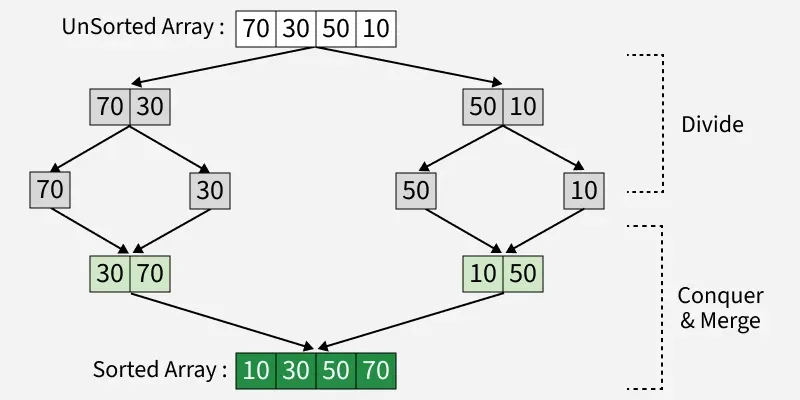
Source: GeeksforGeeks#
Implementation#
#include <vector>

void merge(std::vector<int>& array, int left, int midpoint, int right) {
  int size1 { midpoint - left + 1 };
  int size2 { right - midpoint };
  std::vector<int> L(size1), R(size2);
  for (int i = 0; i < size1; i++) {
    L[i] = array[left + i];
  }
  for (int j = 0; j < size2; j++) {
    R[j] = array[midpoint + 1 + j];
  }
  int i { 0 }, j { 0 };
  int k { left };
  while (i < size1 && j < size2) {
    if (L[i] <= R[j]) {
      array[k] = L[i];
      i++;
    } else {
      array[k] = R[j];
      j++;
    }
    k++;
  }
  while (i < size1) {
    array[k] = L[i];
    i++;
    k++;
  }
  while (j < size2) {
    array[k] = R[j];
    j++;
    k++;
  }
}

void mergeSort(std::vector<int>& array, int left, int right) {
  if (right <= left) return;
  int midpoint { left + (right - left) / 2 };
  mergeSort(array, left, midpoint);
  mergeSort(array, midpoint + 1, right);
  merge(array, left, midpoint, right);
}

int main() {
  std::vector<int> array = { 38, 27, 43, 10 };
  int size = array.size();
  mergeSort(array, 0, size - 1); // { 10, 27, 38, 43 }
}
def merge(array: list[int], left: int, midpoint: int, right: int, /) -> None:
  size1: int = midpoint - left + 1
  size2: int = right - midpoint
  L: list[int] = [0] * size1
  R: list[int] = [0] * size2
  for i in range(size1):
    L[i]: int = array[left + i]
  for j in range(size2):
    R[j]: int = array[midpoint + 1 + j]
  i = j = 0
  k: int = left
  while i < size1 and j < size2:
    if L[i] <= R[j]:
      array[k]: int = L[i]
      i += 1
    else:
      array[k]: int = R[j]
      j += 1
    k += 1
  while i < size1:
    array[k]: int = L[i]
    i += 1
    k += 1
  while j < size2:
    array[k]: int = R[j]
    j += 1
    k += 1

def merge_sort(array: list[int], left: int = 0, right: int = -1, /) -> None:
  size: int = len(array)
  if right < 0:
    right += size
  if right <= left: return
  midpoint: int = left + (right - left) // 2
  merge_sort(array, left, midpoint)
  merge_sort(array, midpoint + 1, right)
  merge(array, left, midpoint, right)

array: list[int] = [ 38, 27, 43, 10 ]
merge_sort(array) # [ 10, 27, 38, 43 ]