Circular Doubly Linked List#
A circular doubly linked list is a complex linear data structure where each node contains a data field and two pointers (next and previous), and the list forms a continuous loop. Specifically, the next pointer of the last node points back to the first node, and the previous pointer of the first node points back to the last node.
Key Characteristics
- Bidirectional Traversal
The concurrent presence of
nextandpreviouspointers allows you to seamlessly traverse the structure both forward and backward.- Perfect Circularity
The
nextpointer of the final node links directly back to the first node (head). Conversely, thepreviouspointer of the head node references the final node.- Absence of Null References
Unlike linear linked lists, this data structure completely eliminates null markers. Every pointer constantly resolves to a valid node address.
- Instant Endpoint Access
Because the head node holds a direct path to the tail via its
previouspointer, you can access or modify either end of the list in \(O(1)\) constant time without performing sequential lookups.- Memory Overhead
This flexibility requires a higher memory allocation footprint because each node must accommodate two distinct pointer variables alongside the user data.
- Infinite Looping Risks
Code loops can execute infinitely if exit conditions do not explicitly watch for the recurrence of the initial starting node.
Advantages and Disadvantages#
- Full Bidirectional Traversal
You can seamlessly step forward (
next) or backward (previous) through the data pool from any starting node.- Instant Back-and-Forth Loops
You can jump from the first item to the last item (and vise versa) in a single step (\(O(1)\) time).
- No Null Pointer Exceptions
The continuous loop structure eliminates code errors caused by accidentally dereferencing an unmapped boundary pointer.
- Higher Memory Footprint
Every item must store two dedicated pointer addresses alongside its actual payload data.
- Complicated Pointer Management
Implementation logic is prone to bugs. Modifying or removing a single node requires changing four distinct pointer references.
- Tricky Termination Conditions
Traditional loops checking for
while(current != nullptr)will result in infinite loops. Code must check ifcurrent == headto safely stop.
Time Complexities of Operations#
- Insertion at Beginning/End: \(O(1)\)
You can instantly grab the last node using
head->prevand adjust the 4 boundary pointers to bridge the new node into the loop.- Insertion at Specific Position: \(O(n)\)
Requires traversing to the target index before adjusting pointers.
- Deletion from Beginning/End: \(O(1)\)
Modifying the connections between the head and tail takes constant time since no linear scanning is required.
- Deletion of a Specific Node: \(O(n)\)
Requires a linear search to find the value before splicing it out.
- Traversal: \(O(n)\)
Because there are no
Nullpointers, a traversal loop must stop when the iterator pointer circles back and equals theHeadpointer.
Visualization#
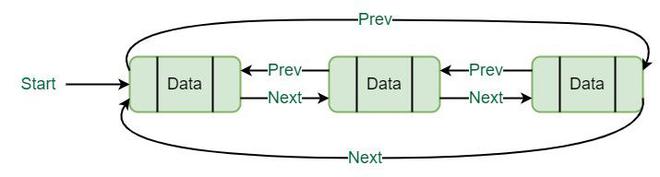
Source: GeeksforGeeks#
Implementation#
#include <iostream>

struct Node {
  int data;
  Node *next;
  Node *previous;

  Node(int data) : data(data), next(nullptr), previous(nullptr) {}
};

class LinkedList {
  private:
    Node *head;

  public:
    LinkedList() : head(nullptr) {}

    void append(int data) {
      Node *node = new Node(data);
      if (head == nullptr) {
        head = node;
        node->next = head;
        node->previous = head;
        return;
      }
      Node *tail = head->previous;
      tail->next = node;
      node->previous = tail;
      node->next = head;
      head->previous = node;
    }

    void prepend(int data) {
      Node *node = new Node(data);
      if (head == nullptr) {
        head = node;
        node->next = head;
        node->previous = head;
        return;
      }
      Node *tail = head->previous;
      node->next = head;
      node->previous = tail;
      tail->next = node;
      head->previous = node;
      head = node;
    }

    void deleteNode(int data) {
      if (head == nullptr) return;
      Node *current = head;
      while (true) {
        if (current->data == data) {
          if (current->next == head && current->previous == head) {
            head = nullptr;
            delete current;
            return;
          }
          current->previous->next = current->next;
          current->next->previous = current->previous;
          if (current == head) {
            head = current->next;
          }
          delete current;
          return;
        }
        current = current->next;
        if (current == head) break;
      }
    }

    void displayForward() {
      if (head == nullptr) return;
      Node *current = head;
      while (true) {
        std::cout << current->data << " -> ";
        current = current->next;
        if (current == head) break;
      }
      std::cout << "(loops back to head)" << std::endl;
    }

    void displayBackward() {
      if (head == nullptr) return;
      Node *current = head->previous;
      while (true) {
        std::cout << current->data << " -> ";
        current = current-> previous;
        if (current == head->previous) break;
      }
      std::cout << "(loops back to tail)" << std::endl;
    }
};
class Node[T]:
  def __init__(self, data: T) -> None:
    self.data: T = data
    self.next: Optional[Node[T]] = None
    self.previous: Optional[Node[T]] = None

class LinkedList[T]:
  def __init__(self) -> None:
    self.head: Optional[Node[T]] = None

  def append(self, data: T) -> None:
    node: Node[T] = Node(data)
    if not self.head:
      self.head: Node[T] = node
      node.next: Node[T] = self.head
      node.previous: Node[T] = self.head
      return
    tail: Node[T] = self.head.previous
    tail.next: Node[T] = node
    node.previous: Node[T] = tail
    node.next: Node[T] = self.head
    self.head.previous: Node[T] = node

  def prepend(self, data: T) -> None:
    node: Node[T] = Node(data)
    if not self.head:
      self.head: Node[T] = node
      node.next: Node[T] = self.head
      node.previous: Node[T] = self.head
      return
    tail: Node[T] = self.head.previous
    node.next: Node[T] = self.head
    node.previous: Node[T] = tail
    tail.next: Node[T] = node
    self.head.previous: Node[T] = node
    self.head: Node[T] = node

  def delete(self, data: T) -> None:
    if not self.head: return
    current: Node[T] = self.head
    while True:
      if current.data == data:
        if current.next == self.head == current.previous:
          self.head: Optional[Node[T]] = None
          return
        current.previous.next: Node[T] = current.next
        current.next.previous: Node[T] = current.previous
        if current == self.head:
          self.head: Node[T] = current.next
        return
      current: Node[T] = current.next
      if current == self.head: break

  def display_forward(self) -> None:
    if not self.head: return
    current: Node[T] = self.head
    elements: list[str[T]] = list()
    while True:
      elements.append(str(current.data))
      current: Node[T] = current.next
      if current == self.head: break
    print(f"{" -> ".join(elements)} -> (loops back to head")

  def display_backward(self) -> None:
    if not self.head: return
    current: Node[T] = self.head.previous
    elements: list[str[T]] = list()
    while True:
      elements.append(str(current.data))
      current: Node[T] = current.previous
      if current == self.head.previous: break
    print(f"{" -> ".join(elements)} (loops back to tail)")