Circular Singly Linked List#
A circular singly linked list is a linear data structure where the last node points back to the first node (head) instead of pointing to Null. Each node contains a single data field and a single next pointer, forming a continuous, closed loop.
Key Characteristics
- No Null Pointers
Traversal does not terminate automatically; it cycles indefinitely unless explicitly stopped.
- Tail Optimization
Keeping a pointer to the
tail(last node) instead of theheadallows \(O(1)\) constant time access to both the first node (tail->next) nad the last node (tail).- Memory Efficiency
It consumes less memory per node than a circular doubly linked list because it only stores one address pointer instead of two.
Advantages and Disadvantages#
- Infinite Looping
Smooth continuous interation without hitting a null-pointer error.
- Any-Node Traversal
You can start traversing from any arbitrary node and still access every element in the list.
- Fast Edge Operations
\(O(1)\) insertions/deletions at both ends when using a tail pointer.
- Infinite Loop Risk
Code errors can easily cause infinite traversal loops if the termination logic is incorrectly handled.
- Complex Management
Harder to reverse or implement safely compared to standard Singly Linked Lists.
- No Backward Traversal
Unidirectional layout requires a full look traversal just to see the previous node.
Time Complexities of Operations#
- Insertion at Beginning: \(O(n)\); \(O(1)\) with
Tailpointer Point new node to head, update tail’s
nextto new node.- Insertion at End: \(O(n)\); \(O(1)\) with
Tailpointer Point tail’s
nextto new node, update tail pointer.- Deletion at Beginning: \(O(n)\); \(O(1)\) with
Tailpointer Update tail’s
nextto point to the second node.- Deletion at End: \(O(n)\)
Requires traversing to the second-to-last node.
- Traversal/Search: \(O(n)\)
Loop sequentially until returning to the starting node.
Visualization#
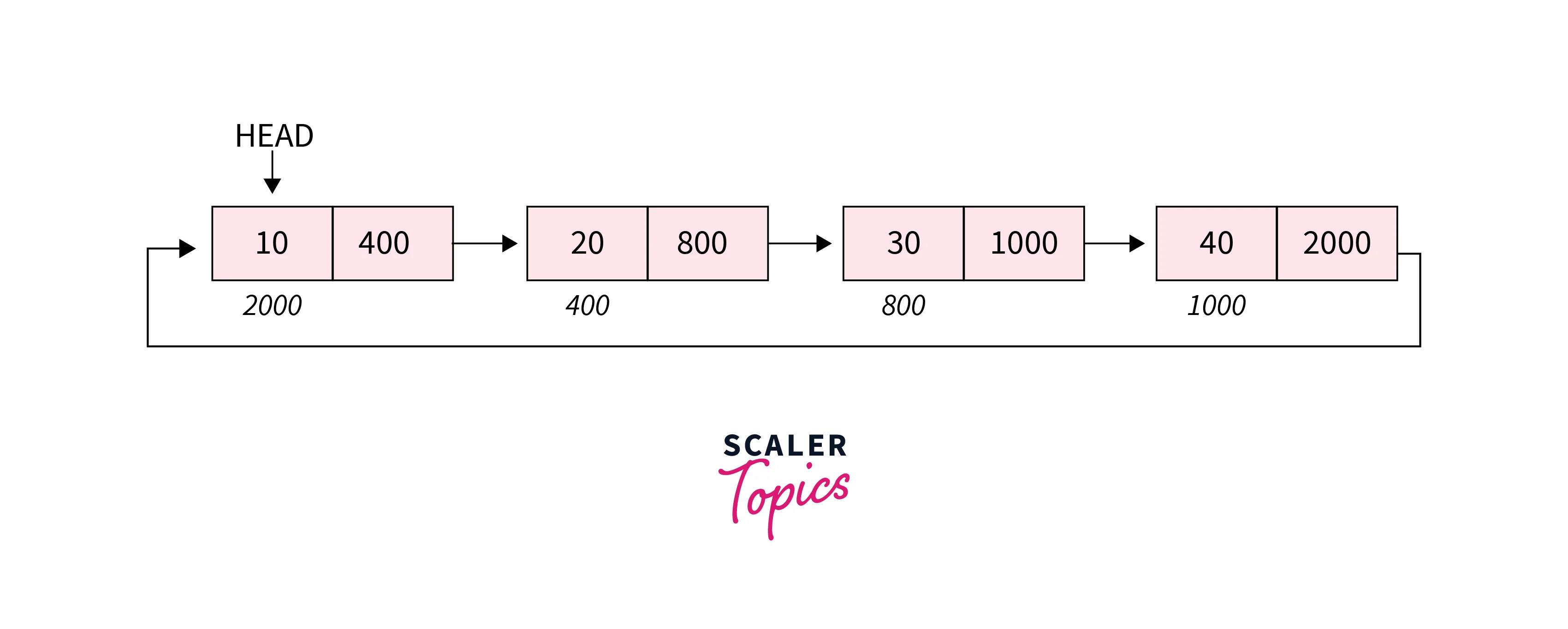
Source: Scaler Topics#
Implementation#
#include <format>
#include <iostream>

struct Node {
  int data;
  Node *next;

  Node(int data) : data(data), next(nullptr) {}
};

class LinkedList {
  private:
    Node *head;

  public:
    LinkedList() : head(nullptr) {}

    void append(int data) {
      Node *node = new Node(data);
      if (head == nullptr) {
        head = node;
        node->next = head;
        return;
      }
      Node *current = head;
      while (current->next != head) {
        current = current->next;
      }
      current->next = node;
      node->next = head;
    }

    void deleteNode(int data) {
      if (head == nullptr) return;
      Node *current = head;
      Node *previous = nullptr;
      if (current->data == data) {
        if (current->next == head) {
          head = nullptr;
          delete current;
          return;
        }
        while (current->next != head) {
          current = current->next;
        }
        Node *node = current->next;
        current->next = head->next;
        head = head->next;
        delete node;
        return;
      }
      current = head;
      while (current->next != head) {
        previous = current;
        current = current->next;
        if (current->data == data) {
          previous->next = current->next;
          delete current;
          return;
        }
      }
    }

    void display() {
      if (head == nullptr) return;
      Node *current = head;
      while (true) {
        std::cout << current->data << " -> ";
        current = current->next;
        if (current == head) break;
      }
      std::cout << std::format("(Back to Head: {})", head->data) << std::endl;
    }

    void prepend(int data) {
      Node *node = new Node(data);
      if (head == nullptr) {
        head = node;
        node->next = head;
        return;
      }
      Node *current = head;
      while (current->next != head) {
        current = current->next;
      }
      node->next = head;
      current->next = node;
      head = node;
    }
};
class Node[T]:
  def __init__(self, data: T) -> None:
    self.data: T = data
    self.next: Optional[Node[T]] = None

class LinkedList[T]:
  def __init__(self) -> None:
    self.head: Optional[Node[T]] = None

  def append(self, data: T) -> None:
    node: Node[T] = Node(data)
    if not self.head:
      self.head: Node[T] = node
      node.next: Node[T] = self.head
      return
    current: Node[T] = self.head
    while current.next != self.head:
      current: Node[T] = current.next
    current.next: Node[T] = node
    node.next: Node[T] = self.head

  def delete(self, data: T) -> None:
    if not self.head: return
    current: Node[T] = self.head
    previous: Optional[Node[T]] = None
    if current.data == data:
      if current.next == self.head:
        self.head: Optional[Node[T]] = None
        return
      while current.next != self.head:
        current: Node[T] = current.next
      current.next: Node[T] = self.head.next
      self.head: Node[T] = self.head.next
      return
    current: Node[T] = self.head
    while current.next != self.head:
      previous: Node[T] = current
      current: Node[T] = current.next
      if current.data == data:
        previous.next: Node[T] = current.next
        return

  def display(self) -> None:
    if not self.head: return
    elements: list[str[T]] = list()
    current: Node[T] = self.head
    while True:
      elements.append(str(current.data))
      if (current := current.next) == self.head: break
    print(" -> ".join(elements) + f" -> (Back to Head: {self.head.data})")

  def prepend(self, data: T) -> None:
    node: Node[T] = Node(data)
    if not self.head:
      self.head: Node[T] = node
      node.next: Node[T] = self.head
      return
    current: Node[T] = self.head
    while current.next != self.head:
      current: Node[T] = current.next
    node.next: Node[T] = self.head
    current.next: Node[T] = node
    self.head: Node[T] = node