Many-to-One#
A many-to-one function is a function where two or more distinct inputs from the domain map to the same single output in the codomain. It satisfies the core rule of a function—each input has only one output—but breaks uniqueness in reverse, meaning multiple inputs share an image.
Key Characteristics
- Lack of Inverse
Because multiple inputs yield the same output, you cannot reverse the mapping uniquely; thus, a many-to-one function is not invertible.
- Cardinality of Sets
For finite sets, the size of the domain can be (and often is) greater than or equal to the size of the range/codomain to force overlapping targets.
- Relation to Surjectivity
A many-to-one function can be ont (surjective) if every element in the codomain is hit by at least one domain element, or into if some codomain elements remain unmapped.
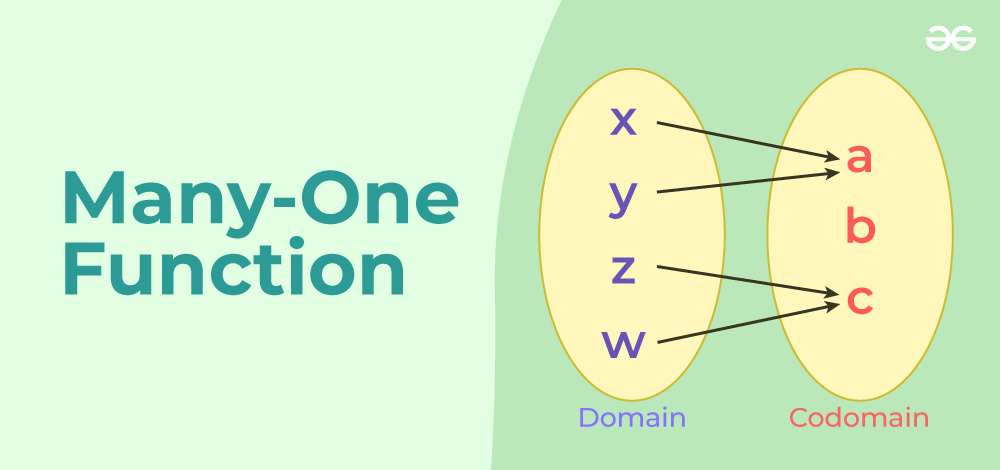
Source: GeeksforGeeks#
How to Prove#
- Verify it is a function.
Show that every input in the domain maps to one and only one output in the codomain.
- State the negation of one-to-one.
A function is not one-to-one if there exist elements \(x_1, x_2\) in the domain such that \(x_1 ≠ x_2\), but \(f(x_1) = f(x_2)\).
- Find a specific counterexample.
Pick two distinct numbers (\(x_1\) and \(x_2\)) from your domain.
- Evaluate the function.
Plug both numbers into the function rule \(f(x)\).
- Demonstrate equality.
Show that \(f(x_1) = f(x_2)\), proving that multiple inputs share a single output.
Example
Let \(f: \mathbb{R} → \mathbb{R}\) be defined by \(f(x) = x ^ 2\).
Choose two different real numbers in the domain: let \(x_1 = 2\) and \(x_2 = -2\). Note that \(x_1 ≠ x_2\) (\(2 ≠ -2\)).
Evaluate the function for both inputs:
Conclude that \(f(2) = f(-2)\) while \(2 ≠ -2\). Because two distinct inputs produce the same output, \(f(x) = x ^ 2\) is not one-to-one and is therefore a many-to-one function.