Surjection#
A surjective function (also called an onto function) is a function where every element in the codomain is mapped to by at least one element from the domain. No element in the target set is left out.
Key Characteristics
- Many-to-One Allowed
Multiple domain elements can point to the same codomain element.
- Composition Rule
The composite of two surjective functions is always surjective.
- Cardinality Constraint
If \(f: A → B\) is surjective, the size (cardinality) of the domain \(A\) must be greater than or equal to the size of the codomain \(B\) (\(|A| ≥ |B|\)).
- Right Invertible
Every surjection has a right inverse \(g: B → A\) such that \(f(g(b)) = b\).
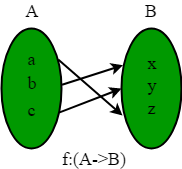
Source: GeeksforGeeks#
How to Prove#
- Let \(y\) be arbitrary.
Start by picking an arbitrary element \(x ∈ Y\) from the codomain.
- Set up the equation.
Write out \(f(x) = y\).
- Solve for \(x\).
Use algebra to solve for \(x\) in terms of \(y\).
- Check the domain.
Confirm that the resulting \(x\)-value belongs to the domain \(X\).
- Verify the mapping.
Substitute your expression for \(x\) back into \(f(x)\) to show that \(f(x) = y\).
Example
Prove that \(f : ℝ → ℝ\) defined by \(f(x) = 3x - 5\) is surjective.
Let \(y\) be an arbitrary real number in the codomain (\(\mathbb{Y} = \mathbb{R}\)).
Set \(f(x) = y\), which gives \(3x - 5 = y\).
Solve for \(x\).
Since \(y \in \mathbb{R}\), \(\frac{y + 5}{3}\) is also a real number, meaning \(x\) is in the domain \(\mathbb{R}\).
Verify.
Since for every \(y \in \mathbb{R}\) there exists an \(x = \frac{y + 5}{3}\) such that \(f(x) = y\), the function \(f\) is surjective.